
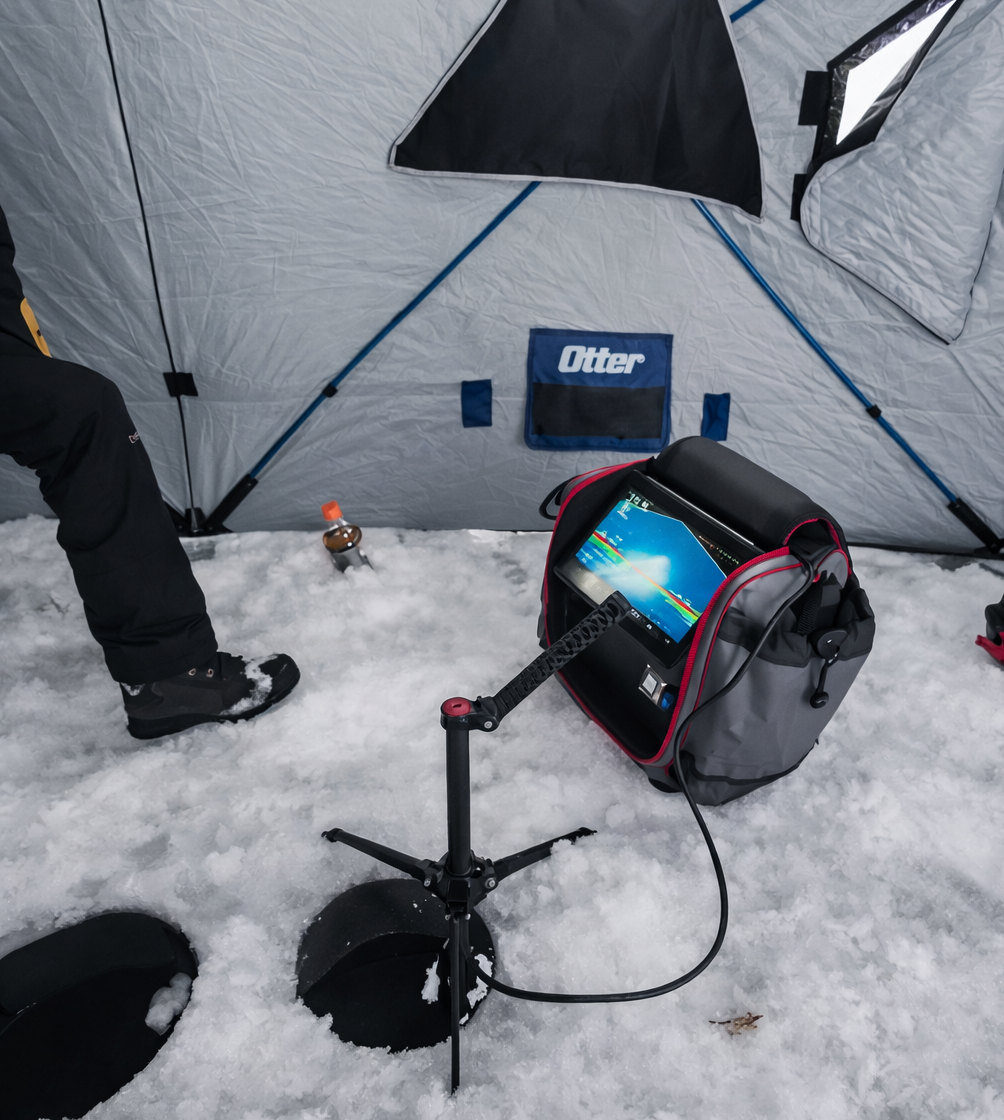
My first impression of Garmin Livescope on Maine waters
Okay, I’ll admit it—I joined the dark side and bought a LiveScope on a Black Friday sale. After resisting this technology for a long time, I finally gave in. But not for the reason you might think.
The real reason I bought LiveScope was for my customers. As a guide, my job is to give them every opportunity to succeed. When fish move deep and start chasing bait in late summer, it can be hard to stay on them. LiveScope gives me a better chance to keep clients fishing where the action actually is.
Since open water is still months away, I set it up for ice fishing first. If I was going to use this technology with clients, I wanted to learn it myself. Ice fishing became my classroom.
I started on a small pond I know well, with strong populations of crappie, perch, bass, and pickerel. I wanted to learn what fish looked like on the screen without wondering if anything was actually there.
On the first hole, I switched to forward-facing mode and saw a moving target near the bottom. I tracked it toward one of my tip-ups. Seconds later, the flag went up. A nice pickerel came through the hole. Watching that happen in real time was surreal.
Next, I went looking for crappie because they suspend. That’s when I learned how much noise matters. I would mark a school, walk over to drill, and they’d disappear. At one point, I watched a group of fish move away just from my kids walking across the ice. Suddenly, LiveScope didn’t look nearly as easy as it does on YouTube.
Over the next few trips, a pattern emerged. Some days you can drill right on top of fish and they don’t care. Other days, you have to be stealthy—set up off to the side and move slowly across the ice. LiveScope didn’t just show me where fish were. It showed me how they react.
Fish in heavy weeds are also hard to see unless they’re moving. Roaming fish like lake trout and salmon rarely hold still. LiveScope doesn’t make them easy to catch, but it does help identify transition areas like weed edges and rock-to-sand bottoms.
What this technology really provides is insight. It shows what’s happening under the surface in a way we’ve never had before. With practice, it can increase your chances of success. But that leads back to the big question:
Is LiveScope cheating?
Do we need tighter restrictions on electronics? Or should the focus stay on fish limits and conservation instead of technology? I’m still forming my opinion, and I’d love to hear yours.
Leave a comment and let me know what you think.

Leave a Reply